



WIAS R-packages for imaging / neuroscience
The software packages in this collection are developed at the Weierstrass Institute for Applied Analysis and Stochastics. They implement new methodology for adaptive data processing in imaging and neurosciences. The packages are ususally developed with the R language and environment for statistical computing and graphics and released as CRAN packages an at the WIAS GitHub community under the GPL license. For broader visibility and special purposes the method are intergrated in other software packages, sometimes with some other approriate license.
WIAS software collection for Imaging
Package "adimpro" for R
This packages provides functions for structure adaptive smoothing of digital images. This includes I/O functions for several image formats (including RAW), which relies on ImageMagick, image analysis and processing tools.
Authors: Karsten Tabelow (Maintainer), Joerg Polzehl
Reference, including documentation:
J. Polzehl, K. Tabelow. Adaptive smoothing of digital images: The R package adimpro., Journal of Statistical Software 19(1), (2007).
Download: freely available from CRAN server under GPL.
The AWS for AMIRA (TM) plugin
The AWS for AMIRA (TM) plugin implements a structural adaptive smoothing procedure for two- and three- dimensional images in the visualization software AMIRA (TM). It is available in the Zuse Institute Berlin's version of the software for research purposes (http://amira.zib.de/).
WIAS software collection for Neuroscience
Package "fmri" for R
The R-package "fmri" provides functions for analyzing single run fmri data with structure adaptive smoothing procedure. This includes I/O function for ANALYZE, AFNI, or DICOM files, linear modelling with hemodynamic response functions, signal detection using Random Field Theory. Additionally, the structural adaptive segmentation method from Polzehl et al. 2010 is implemented.
Authors: Karsten Tabelow (Maintainer), Joerg Polzehl with contributions by Devy Hoffmann
References:
K. Tabelow, J. Polzehl, H.U. Voss, and V. Spokoiny. Analyzing fMRI experiments with structural adaptive smoothing procedures., NeuroImage 33(1), pp. 55-62 (2006).
J. Polzehl, H.U. Voss, K. Tabelow, Structural adaptive segmentation for statistical parametric mapping, NeuroImage, 52(2) pp. 515--523 (2010).
Polzehl and Tabelow, Magnetic Resonance Brain Imaging: Modeling and Data Analysis with R 2nd Revised Edition, Series: Use R!, Springer International Publishing, Cham, 2023, 258 pages.
Documentation:
J. Polzehl, K. Tabelow. Analyzing fMRI experiments with the fmri package in R. Version 1.0 - A users guide. WIAS-Technical Report No. 10 (2006)
J. Polzehl, K. Tabelow. fmri: A package for analyzing fmri data, RNews 7(2) 13-17 (2007).
K. Tabelow, J. Polzehl. Statistical parametric maps for functional MRI experiments in R: The package fmri., Journal of Statistical Software 44(11), (2011).
Download: freely available from CRAN, GitHub or NITRC server under GPL.
Package "dti" for R
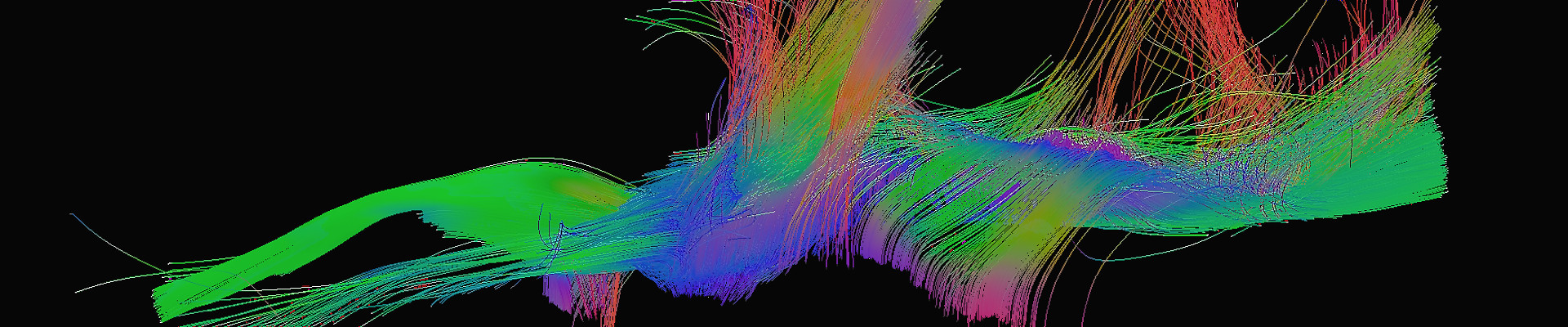
The package contains tools for the analysis of diffusion-weighted magnetic resonance imaging data (dMRI). It can be used to read dMRI data, to estimate the diffusion tensor, for the adaptive smoothing of dMRI data, the estimation of orientation density functions or its square root, the estimation of tensor mixture models, the estimation of the diffusion kurtosis model, fiber tracking, and for the two- and three-dimensional visualization of the results.
Authors: Karsten Tabelow (Maintainer), Joerg Polzehl with contributions by Felix Anker
References:
K. Tabelow, J. Polzehl, V. Spokoiny, and H.U. Voss. Diffusion Tensor Imaging: Structural adaptive smoothing, NeuroImage 39(4), pp. 1763-1773 (2008).
S. Becker, K. Tabelow, H.U. Voss, A. Anwander, R.M. Heidemann, J. Polzehl, Position-orientation adaptive smoothing of diffusion weighted magnetic resonance data (POAS), Med. Image Anal., 16(1) pp. 200--211 (2012)
K. Tabelow, H.U. Voss, J. Polzehl, Modeling the orientation distribution function by mixtures of angular central Gaussian distributions, J. Neurosci. Meth., 203 pp. 200--211 (2012).
S. Becker, K. Tabelow, S. Mohammadi, N. Weiskopf, J. Polzehl, Adaptive smoothing of multi-shell diffusion-weighted magnetic resonance data by msPOAS, NeuroImage 95, pp. 90--105 (2014).
K. Tabelow, H.U. Voss, and J. Polzehl, Local estimation of the noise level in MRI using structural adaptation, Medical Image Analysis 20, pp. 76--86 (2015)
Polzehl and Tabelow, Magnetic Resonance Brain Imaging: Modeling and Data Analysis with R 2nd Revised Edition, Series: Use R!, Springer International Publishing, Cham, 2023, 258 pages.
Documentation:
J. Polzehl, K. Tabelow. Structural adaptive smoothing in diffusion tensor imaging: The R package dti, Journal of Statistical Software 31(9), (2011).
J. Polzehl, K. Tabelow, Beyond the Gaussian model in diffussion-weighted imaging: The package dti, Journal of Statistical Software 44(12) (2011).
Download: freely available from CRAN, GitHub or NITRC server under GPL.
Package "qmri" for R
The package contains tools for the analysis of quantitative magnetic resonance imaging data (dMRI), i.e., data from MPM or inversion recovery MR sequences. It can be used to read such data, to estimate parameters of sepcific models, for the adaptive smoothing of the respective data.
Authors: Karsten Tabelow (Maintainer), Joerg Polzehl
References:
S. Mohammadi, Ch. D'Alonzo, L. Ruthotto, J. Polzehl, I. Ellerbrock, M.F. Callaghan, N. Weiskopf, and K. Tabelow. Simultaneous adaptive smoothing of relaxometry and quantitative magnetization transfer mapping, WIAS Preprint 2432 (2017).
Polzehl and Tabelow, Magnetic Resonance Brain Imaging: Modeling and Data Analysis with R 2nd Revised Edition, Series: Use R!, Springer International Publishing, Cham, 2023, 258 pages.
Download: freely available from CRAN, or GitHub server under GPL.
ACID-Toolbox for SPM
The ACID-Toolbox contains a number of tools for Artifact Correction in dMRI. It contains an implementation of msPOAS in Matlab. It can be used withing the neuroimaging software SPM.
Reference:
K. Tabelow, S. Mohammadi, N. Weiskopf, and J. Polzehl (2015), POAS4SPM --- A toolbox for SPM to denoise diffusion MRI data, Neuroinformatics 13 pp. 19-29 (2015).
G. David, B. Fricke, J.M. Oeschger, L. Ruthotto, F.J. Fritz, O. Ohana, T. Sauvigny, P. Freund, K. Tabelow and S. Mohammadi (2023), ACID: A Comprehensive Toolbox for Image Processing and Modeling of Brain, Spinal Cord, and Ex Vivo Diffusion MRI Data bioRxiv 2023.10.13.562027
aws4SPM
This is a toolbox for SPM that implements structural adaptive smoothing for fMRI in SPM. Its main page can be found here. The package was re-written to fit the SPM toolbox API and is now released for donwload again.
Note
The packages come with absolutely NO WARRANTY! It is not intended for any purpose! It is especially not intended for any clinical use, but for evaluation purpose only.
Karsten Tabelow Last modified: Fri Mar 15 14:45:00 CET 2024

Contact
Phone, E-mail
Tel.: 030 20372-564
E-mail: imaging@wias-berlin.de

WIAS Research Software
- ALEA - Framework for high-dimensional functional Uncertainty Quantification
- aws - Adaptive weights smoothing
- BALaser for the simulation of dynamics in broad-area semiconductor lasers
- ddfermi - drift diffusion simulation tool
- WIAS R-packages for imaging / neuroscience
- LDSL-tool for the simulation of longitudinal dynamics in semiconductor lasers
- pdelib - a FVM and FEM toolbox for PDEs
- TetGen - a Delaunay Tetrahedral Mesh Generator