Lecture on Particle systems with contact interaction
Sommersemester 2026, TU Berlin
Lecturer and contact information:
- Dr. Lukas Lüchtrath, luechtrath (at) wias-berlin.de
- No lecture on June 9th.
Content:
-
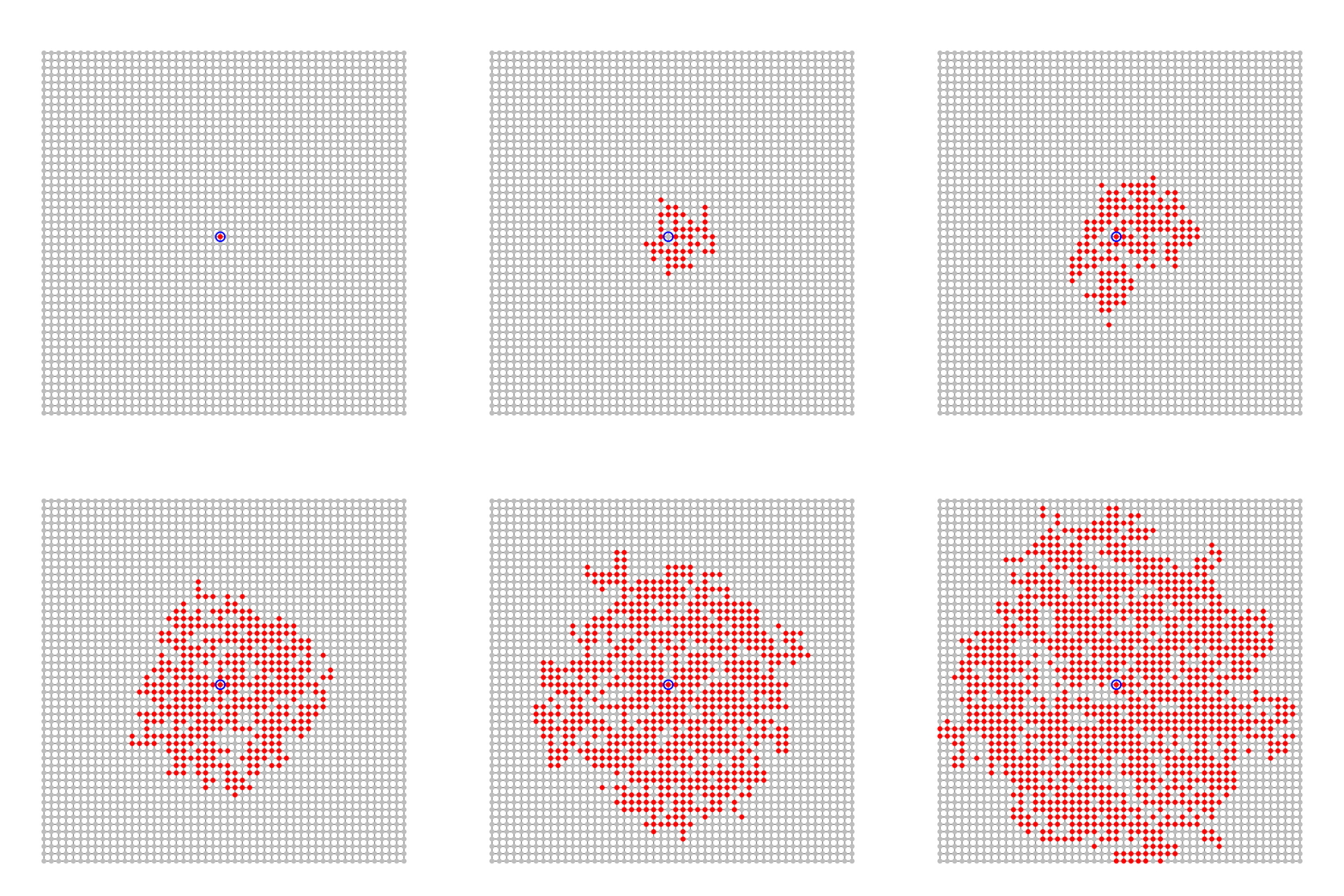
Interacting particle systems are probabilistic models that lie at the “sweet spot” between showing real complexity while still being mathematically tractable. One specifies local random update rules on a lattice or a graph, and out comes global behaviour that is often universal, geometry-dependent, and mathematically deep. In this lecture we focus on particle systems with contact interaction that display surprisingly rich phenomena like nontrivial invariant measures, scaling limits, and genuine phase transitions driven by geometry and dimension. The guiding example is the contact process: a stochastic birth–death dynamics on a graph modeling the spread of an infection (or activity) through nearest-neighbor transmission and spontaneous recovery.
The course focuses on the contact process, emphasizing equivalent representations and the techniques they unlock: the graphical (Harris) construction, duality, couplings and monotonicity, and connections to oriented percolation and renormalization ideas. We develop a rigorous understanding of the subcritical/supercritical regimes, the critical infection rate. Depending on time and the students' preferences, we discuss metastability (e.g. long survival in finite volume and quasi-stationarity) and contrast Euclidean lattices with trees, where non-amenability leads to distinctive phase diagrams (including multiple thresholds).
Lecture information:
-
- Audience: Students specialising in probability. The knowledge of "Wahrscheinlichkeitstheorie 1" is mandatory.
- Times: Tuesdays 8:30 - 10:00 in MA642, starting on 14 April.
- Assessment: Oral exams. Examination is possible on either 18.08., 19.08., or 22.09., 23.09. Please send me an e-mail with your prefered day and time (morning or afternoon) together with this form. For Prüfungszeitraum simply write August 2026 - September 2026.
- Language: English
- Thesis in this field: Participants of the lecture qualify for a thesis in one of the topics concerning interacting particle systems under the supervision of Prof. Wolfgang König
- ISIS page
- Credit points: 5 CP
- Lecture notes. Updated during the course. No guarantee for completeness. If you find any typos and mistakes, please let me know (last update 17.07.)
References